Local SEO in 2026
Local SEO in 2026 looks nothing like it did five years ago. Back then, you could stuff a few keywords on a page, submit your business to a hundred directories, and watch your rankings climb. Google caught on to that game a long time ago. Today, ranking a local business takes real strategy, real content, and real trust signals.
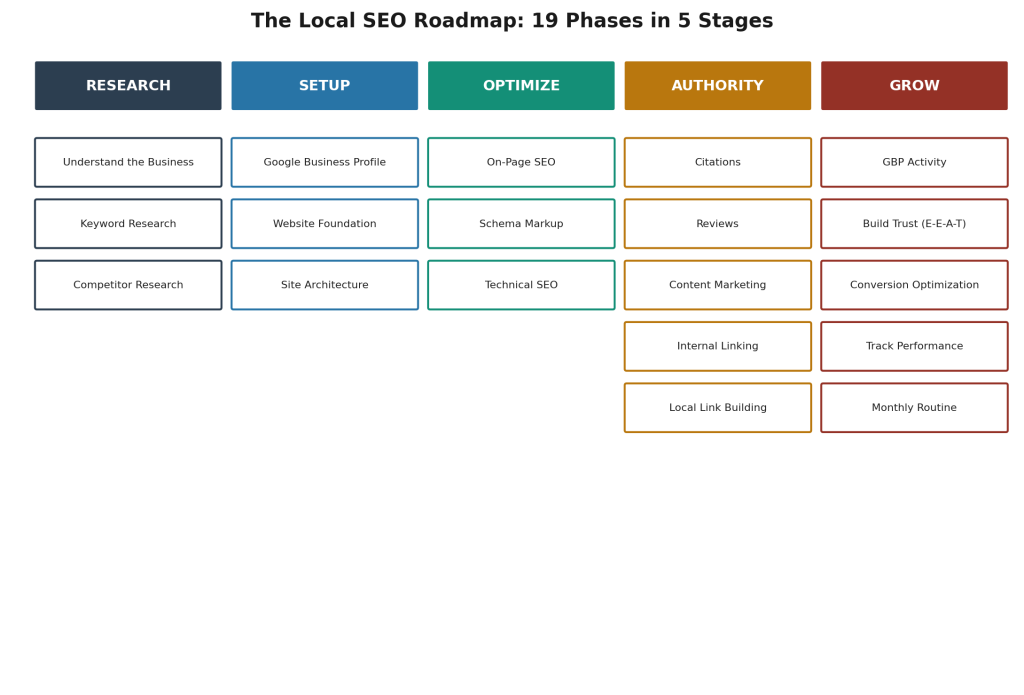
This guide breaks down the entire process into clear phases. Whether you run a plumbing company in Ohio or a dental clinic in Texas, these steps apply to almost any local business. Follow them in order, and you will build a foundation that keeps working long after the algorithm changes again.
Phase 1: Learn the Business Before You Touch SEO
Every good SEO campaign starts with research, not tools. Before you open Google Search Console or write a single meta tag, sit down and learn the business inside and out.
Ask questions like these:
- What services does the business actually offer?
- What makes this business different from the competition down the street?
- Who is the ideal customer, and what do they care about?
- Which cities or neighborhoods does the business serve?
- Which services bring in the most profit?
- Who are the top three competitors in the local market?
- What words do real customers type into Google when they need this service?
Skipping this step is the most common mistake new SEO practitioners make. A roofing company in Dallas has different customers, different pain points, and different search behavior than a roofing company in Miami. You cannot build a campaign on assumptions.
Phase 2: Do Real Keyword Research
Once you understand the business, move on to keyword research. This is the foundation everything else gets built on.
Look for these keyword types:
- Primary keywords (the main service, like “roof repair”)
- Service keywords (specific offerings, like “shingle replacement”)
- Commercial keywords (words that show buying intent)
- Emergency keywords (for businesses that handle urgent jobs)
- “Near me” searches
- Local intent keywords tied to a city or neighborhood
- Long-tail keywords (longer, more specific phrases)
- Question keywords (what people ask, not just search)
- Voice search phrases (how people talk, not type)
- Competitor keywords (terms your rivals already rank for)
For tools, start with what is free. Google’s own Keyword Planner gives you real search volume data straight from the source. Pay attention to Google Autocomplete and the “People Also Ask” box, since both reflect real, current searches. Once you have a budget, paid tools like Ahrefs and Semrush add competitive data that free tools cannot match.
Phase 3: Study the Competitors Already Ranking
Before you build anything, look at the businesses already sitting in the Local Pack for your target keywords. These are the businesses Google already trusts, and there is a reason for that.
Study their:
- Google Business Profile setup
- Website structure and navigation
- Category choices
- Review count and review content
- Backlink profile
- Citation consistency
- Service and location pages
- Internal linking patterns
- Content depth and quality
- Photos and videos
- FAQ sections
This is not about copying anyone. It is about understanding what Google rewards in your specific market. A landscaping company ranking in Phoenix may lean heavily on before-and-after photos, while a law firm ranking in Chicago may lean on detailed case results and credentials. Every industry has different trust signals.
Phase 4: Build Out the Google Business Profile Completely
Your Google Business Profile is the single most important asset in local SEO. Google’s own Business Profile Help Center is the best place to check for current setup instructions, since Google updates its features often.
Fill out every section:
- Primary category
- Secondary categories
- Business description
- Services
- Products
- Business hours and holiday hours
- Appointment link
- Website
- Phone number
- Messaging
- Attributes
- Opening date
- Service areas
Then upload real visual content. This means your logo, a strong cover photo, team photos, office photos, equipment or vehicle photos, before-and-after shots, completed project photos, and video walkthroughs where possible. Google’s guide on how to edit and manage your Business Profile covers the specifics of setting your service area and hours correctly, which matters more than most people realize.
An incomplete profile signals to Google that the business is not active or not fully verified. A complete profile signals the opposite.
Phase 5: Build a Solid Website Foundation
Every local business website needs a core set of pages to function well for both users and search engines:
- Homepage
- About page
- Contact page
- Reviews page
- FAQ page
- Blog
- Service pages
- Location pages
- Privacy policy
- Terms of service
- Sitemap
Beyond having these pages, the site needs to load fast, run on HTTPS, and work smoothly on a phone. Most local searches now happen on mobile devices, so a site that looks great on a laptop but loads slowly on a phone will lose customers before they even see your services.
Phase 6: Organize the Website Architecture
Site structure matters more than most business owners think. A clean structure helps both users and search engines understand what you offer and where you offer it.
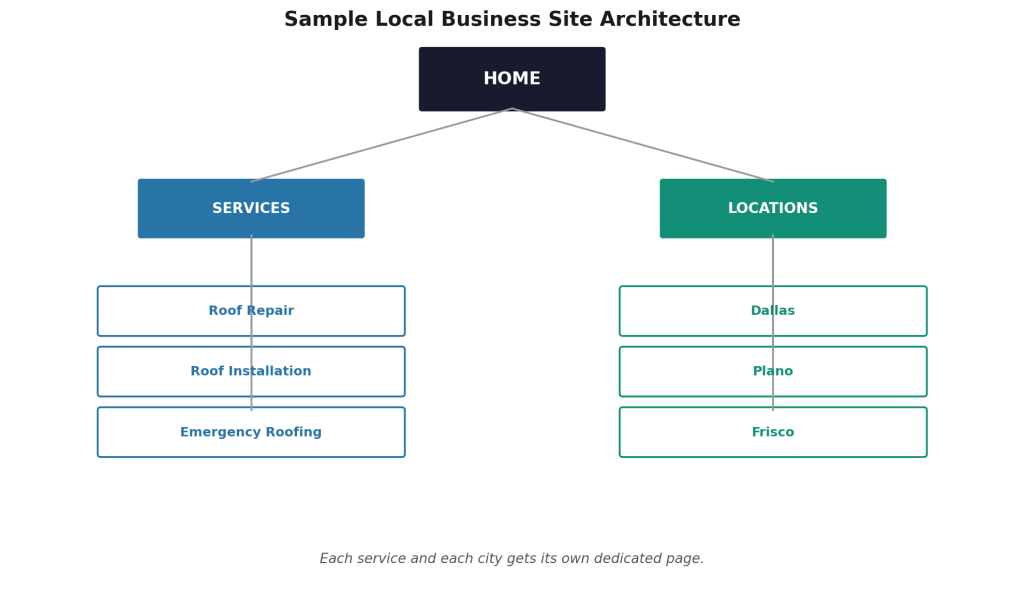
A good structure looks like this:
Home
Services
  → Roof Repair
  → Roof Installation
  → Emergency Roofing
Locations
  → Dallas
  → Plano
  → Frisco
Give each service its own page. Give each city you serve its own page. Avoid duplicating the same content across multiple location pages with only the city name swapped out, since Google can flag this as thin or duplicate content. Each location page should mention specific neighborhoods, local landmarks, or details that make it genuinely useful to someone searching from that area.
Phase 7: Handle On-Page SEO for Every Page
Every page on the site, whether it is a service page or a blog post, should include these on-page elements:
- The target keyword in the title tag
- A clear meta description
- A clean, readable URL
- One H1 heading
- Supporting H2 and H3 headings
- Internal links to related pages
- A few external links to authoritative sources
- Optimized images with descriptive file names
- Alt tags on every image
- An FAQ section addressing common questions
- A clear call to action
- An embedded map where it makes sense
- Links to related services and related locations
None of this is complicated, but skipping even a few of these elements weakens the page. Think of on-page SEO as giving Google (and your visitors) every possible clue about what the page is about and why it matters.
Phase 8: Add Structured Data (Schema Markup)
Structured data helps search engines understand your content in a way plain text cannot. Google maintains detailed documentation on structured data for local businesses that walks through exactly which schema types to use and how to format them.
Focus on these schema types:
- LocalBusiness
- Organization
- Service
- Review
- FAQ
- Breadcrumb
- Video
- Person
- Website
You can find the technical specifications for any of these types on Schema.org itself, which is the reference standard that Google, Bing, and other search engines pull from. Adding schema will not guarantee rich results, but it removes ambiguity and gives Google a clearer picture of your business.
Phase 9: Fix the Technical SEO Basics
Technical SEO is the plumbing behind the site. If it is broken, nothing else works well no matter how good your content is.
Check these regularly:
- Core Web Vitals
- Mobile friendliness
- HTTPS setup
- XML sitemap
- Robots.txt file
- Canonical tags
- Broken links
- Redirect chains
- Crawl errors
- Page speed
- Image compression
- Lazy loading
- Index coverage in Search Console
Google Search Console is free and gives you direct insight into how Google actually sees your site, including which pages are indexed and which have errors. Run through it monthly at minimum.
Phase 10: Build Citations the Right Way
Citations are online mentions of your business name, address, and phone number, usually called NAP. Consistency across every platform matters far more than the total number of citations you have.
Submit your business to trusted platforms including:
- Apple Maps
- Bing Places
- Yelp
- Better Business Bureau
- Relevant industry directories
- Local Chamber of Commerce
- Local business directories
If your business name is listed as “Smith Plumbing LLC” on one site and “Smith Plumbing” on another, that small inconsistency can confuse search engines about which listing is accurate. Take the time to standardize your NAP information before you submit it anywhere.
Phase 11: Build a Real Review System
Reviews influence both rankings and whether a potential customer actually calls you. A business with 200 reviews at 4.8 stars will almost always outperform a competitor with 12 reviews, even if that competitor’s website is more polished.
Build a simple, repeatable review system:
- Ask every satisfied customer for a review
- Follow up by text or email after the job is done
- Share a QR code that links directly to your review page
- Respond to every review, positive or negative
- Encourage customers to mention the specific service and city in their review naturally
Never buy fake reviews. Google actively detects and penalizes this behavior, and it can lead to a suspended profile. The Better Business Bureau is also a useful platform to build trust with customers who research businesses before calling.
Phase 12: Publish Content That Actually Helps People
Google rewards businesses that consistently publish useful, original content. This does not mean churning out generic blog posts. It means answering real questions your customers already have.
Good content types include:
- Detailed service pages
- City-specific location pages
- FAQ pages
- Cost guides (how much does X typically cost)
- Comparison articles
- Case studies
- Project showcases
- Before-and-after galleries
- Maintenance tips
- Seasonal advice
- Local news relevant to your industry
- Community updates
- Customer success stories
Every piece of content should answer a question a real customer would type into Google. If you cannot picture the exact person searching for it, the content probably will not perform well.
Phase 13: Link Your Pages Together Strategically
Internal linking connects your pages in a way that helps both users and search engines navigate your site.
Link:
- Services to related services
- Locations to nearby locations
- Blog posts to relevant service pages
- FAQ answers to the pages they relate to
- Case studies to the services they showcase
A strong internal linking structure spreads authority across your site and keeps visitors browsing longer instead of leaving after one page.
Phase 14: Build Local Links
Backlinks from other local, relevant websites remain one of the strongest ranking signals in local SEO. Focus on relevance over sheer quantity.
Good sources include:
- Chamber of Commerce websites
- Local brands and businesses you partner with
- Community organizations
- Suppliers and manufacturers
- Local blogs and news sites
- Niche industry sites
- Guest posts on relevant sites
- Active social media profiles
A single link from a well-known local newspaper is worth far more than fifty links from low-quality directories nobody visits.
Phase 15: Keep Your Google Business Profile Active
An active profile sends a strong positive signal to Google. Businesses that update their profile regularly tend to outperform those that set it up once and never touch it again.
Every month:
- Upload new photos
- Add project videos
- Publish profile updates
- Post current offers or promotions
- Answer questions in the Q&A section
- Update your service list
- Refresh outdated business information
This takes maybe twenty minutes a month but signals to Google that a real, operating business is behind the listing.
Phase 16: Build Trust Signals (E-E-A-T)
Google wants to rank businesses that people can actually trust. This concept, often shortened to E-E-A-T (Experience, Expertise, Authoritativeness, Trustworthiness), shows up throughout Google’s own Search Quality Rater Guidelines.
Show real trust signals:
- Real team members with names and photos
- Office and facility photos
- Company history
- Certifications and licenses
- Awards
- Insurance information
- Customer testimonials
- Detailed case studies
- Before-and-after project results
Trust is not a soft, feel-good metric. It is a real factor that influences how Google evaluates and ranks your business.
Phase 17: Optimize for Conversions, Not Just Rankings
Ranking at the top of Google means nothing if visitors do not become customers. Once your rankings improve, shift focus to conversion optimization.
Add these elements to your site:
- Click-to-call buttons, especially on mobile
- Fast, simple contact forms
- Online booking if it fits your business
- Live chat
- Strong, clear calls to action
- Trust badges (BBB, licensing, insurance)
- Financing options if applicable
- Guarantees
- Social proof like review counts and testimonials
Every improvement in conversion rate makes your existing traffic more valuable, without needing a single additional visitor.
Phase 18: Track What Actually Matters
You cannot improve what you do not measure. Set up tracking before you need it, not after.
Track:
- Keyword rankings
- Google Maps rankings
- Organic traffic
- Phone calls generated from the site
- Form submissions
- Direction requests from Google Maps
- Website clicks
- Review growth over time
- Total leads
- Revenue attributable to SEO
Google Search Console and Google Analytics together give you most of this data for free. Set up call tracking separately if phone calls are a major conversion path for the business.
Phase 19: Follow a Monthly SEO Routine
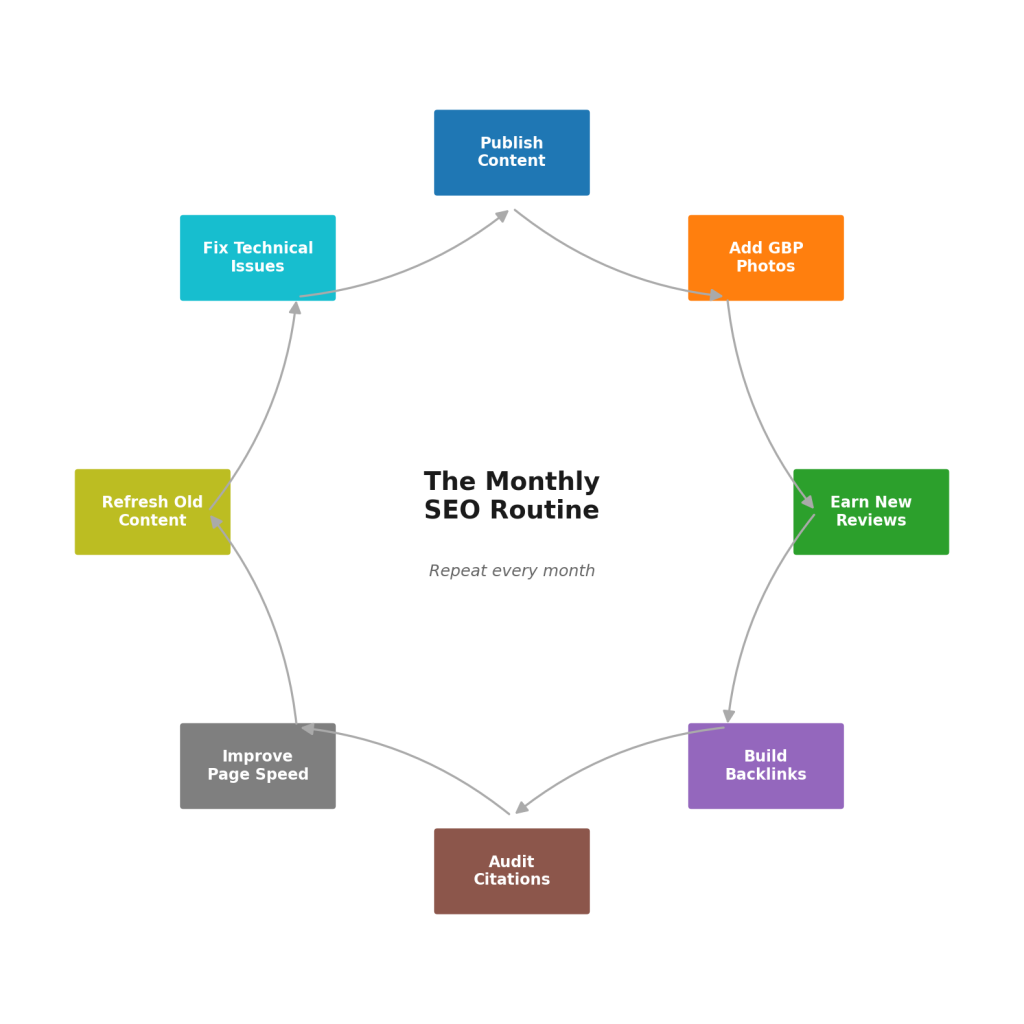
Local SEO is not a project with a finish line. It is an ongoing process that compounds over time.
Every month, aim to:
- Publish new content
- Add fresh photos to the Google Business Profile
- Publish Google Business Profile posts
- Earn new reviews
- Build a few quality backlinks
- Audit citations for consistency
- Improve page speed where possible
- Refresh older content with updated information
- Update FAQs based on new customer questions
- Fix any technical issues found in Search Console
- Monitor what competitors are doing
- Track ranking changes
Final Thoughts
Local SEO in 2026 rewards businesses that act like real businesses online, not businesses that treat SEO as a checklist to complete once. The strategies that work are the same ones that have always worked in some form: build a real, useful website, earn genuine trust, serve your community well, and stay consistent over time.
Start with the phases in order. Do not skip the research phase to jump straight into technical fixes, and do not build content without understanding the business first. Master these fundamentals, apply them consistently, and you will have the skills to rank almost any local business, in almost any industry, for years to come.